




1. Proficiency Testing
Proficiency testing (PT) is the evaluation of a laboratory’s performance against pre-established criteria by means of interlaboratory comparisons. It’s used to demonstrate competency and validate a laboratory’s measurement process by comparing its results to the results of a reference laboratory and other participant laboratories.
Goals of Proficiency Testing
• To provide laboratories with support and information in improving the quality of their
testing and/or measurements.
• To give laboratories an unbiased method of demonstrating and evaluating the reliability
of their data.
• To add an external evaluation of the testing/calibration capabilities of laboratories.
• To boost laboratories’ internal quality control processes.
The National Tuberculosis Reference Laboratory has established and maintained a proficiency testing scheme for most TB laboratory diagnostics including conventional microscopy and WHO-recommended molecular diagnostic e.g., GeneXpert. The NTRL provides an annual PT calendar that states the frequency of each scheme to prospective customers so that laboratories can enrol in a scheme of their choice on an annual basis.
Due to the large number of laboratories performing smear microscopy, there is limited capacity to produce microscopy PT for all the laboratories in the network hence, PT for microscopy will only be provided to accredited laboratories and laboratories that are earmarked for accreditation within the stated calendar year. The NHLDS is establishing the National External Quality Assurance department that will oversee and coordinate all proficiency testing schemes in the country.
2. Blinded Rechecking of Routine Slides
Blinded rechecking is the EQA process that involves re-reading a statistically valid sample of slides from a laboratory to assess whether that laboratory has an acceptable level of performance. Blinded rechecking is based on Lot Quality Assurance Sampling (LQAS); randomly selected slides from the routine workload of the laboratories are sent to a higher laboratory (first controller) for validation.
The WHO refers to blinded rechecking as the EQA method that provides reliable assurance that a country has an effective AFB microscopy network because it only functions in through a network. Blinded rechecking;
a) Reflects reality of routine performance by checking:
✓ Sample Quality
✓ Smear technique
✓ Stain performance and
✓ Accuracy of reading
b) Motivates staff an accurate and practical Blinded rechecking system should ensure that;
a) The sample contains a sufficient number of randomly selected slides to be representative.
b) The first controller (re-checker) must be unaware of the original result of the peripheral laboratory lab personnel to prevent bias, i.e. is “blinded”.
c) Minor errors, representing false positive or false negative interpretations of 1-9 AFB/100
fields, are included with major errors to obtain a smaller sample size. The smaller sample size facilitates the implementation and sustainability of rechecking programs.
d) A second controller resolves discrepant results.
e) There must be a system to provide timely feedback and improvements to the Laboratories that are supervised.
Blinded rechecking in the TB Laboratory network is done for all active diagnostic centres from Health Centre III Level to Regional Hospitals. It is coordinated through the normal NHLDS
structures from the National TB Reference Laboratory to the lowest peripheral laboratories. The regionalization strategy that the MOH is adopting is to ensure that the intermediate levels activities are transitioned to the Reginal Referral Hospital with oversight of laboratories at the district levels.
All microscopy laboratories to be rechecked under blinded re-checking should have: a) Sufficient slide boxes to store all slides for at least one quarter.
b) Tools for permanent labelling of slides for proper identification: either pencils (for slides with frosted ends) or a diamond marker (for plain slides).c) An NTLP Laboratory Register.
d) Staining facility, microscopes, and reagents.
e) A piece of absorbent paper for example newspaper for use to remove oil from the slides before storing them in the slide box.
First Controllers (DLFP and/or chosen staff in the District Lab) need;
a) A good microscope.
b) Sufficient time.
c) Xylene (for the labs doing rechecking of slides stained by the ZN technique).
d) Staining facilities and equipment.
Second controllers (Regional laboratory supervisors) need
a) A good microscope.
b) Sufficient time.
c) Discordant forms for listing discordant results.
d) A computer and its printer for compiling and printing feedback reports and quarterly summary performance reports for DTLS, regional and NTLP and data entry in the regional analysis sheets.
e) An EQA Excel Database for analysis of District and Zonal data entries.
The flow of activities for blinded rechecking in the Uganda TB lab Network is as demonstrated in the flow chart shown below
Flowchart of blinded re-checking activities, NTLP Uganda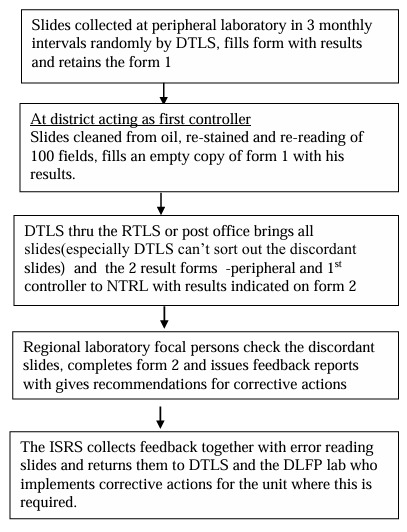
Based on the Lot Quality Assurance System (LQAS), Uganda blinded rechecking program
randomly samples 10 slides per lab per quarter.